
Solutions specialist is reimagining scheduling and operations with a new platform built from the ground up and shaped by the industry
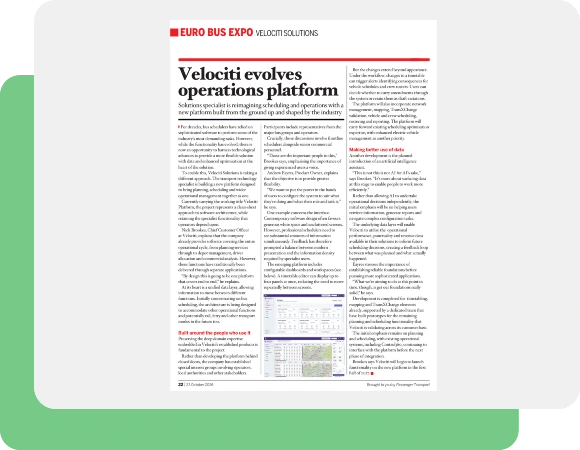
For decades, bus schedulers have relied on sophisticated software to perform some of the industry’s most demanding tasks. However, while the functionality has evolved, there is now an opportunity to harness technological advances to provide a more flexible solution with data and enhanced optimisation at the heart of the solution.
To enable this, Velociti Solutions is taking a different approach. The transport technology specialist is building a new platform designed to bring planning, scheduling and wider operational management together as one.
Currently carrying the working title Velociti Platform, the project represents a clean-sheet approach to software architecture, while retaining the specialist functionality that operators depend upon.

Nick Brookes, Chief Customer Officer at Velociti Solutions, explains that the company already provides software covering the entire operational cycle, from planning services through to depot management, driver allocation and commercial analysis. However, these functions have traditionally been delivered through separate applications.
“By design this is going to be one platform that covers end to end,” he explains.
At its heart is a unified data layer, allowing information to move between different functions. Initially concentrating on bus scheduling, the architecture is being designed to accommodate other operational functions and potentially rail, ferry and other transport modes in the future too.
Built around the people who use it
Preserving the deep domain expertise embedded in Velociti’s established products is fundamental to the project. Rather than developing the platform behind closed doors, the company has established special interest groups involving operators, local authorities and other stakeholders.
Participants include representatives from the major bus groups and operators. Crucially, those discussions involve frontline schedulers alongside senior commercial personnel.
“Those are the important people in this,” Brookes says, emphasising the importance of giving experienced users a voice.

Andrew Eayres, Product Owner, explains that the objective is to provide greater flexibility. “We want to put the power in the hands of users to configure the system to suit what they’re doing and what their role and task is,” he says.
One example concerns the interface. Contemporary software design often favours generous white space and uncluttered screens. However, professional schedulers need to see substantial amounts of information simultaneously. Feedback has therefore prompted a balance between modern presentation and the information density required by specialist users.
The emerging platform includes configurable dashboards and workspaces. A timetable editor can display up to four panels at once, reducing the need to move repeatedly between screens.
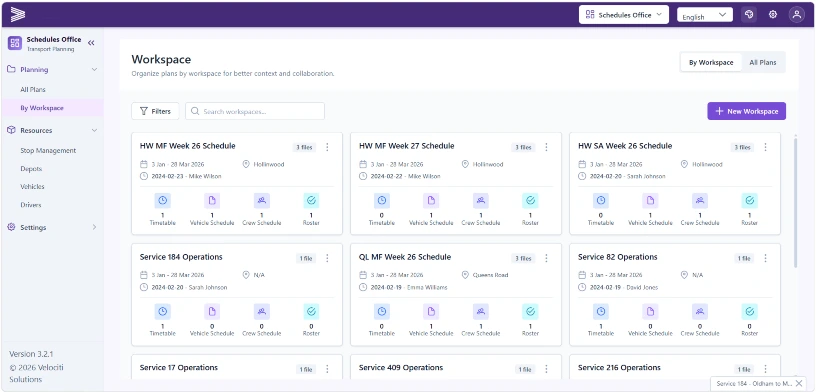
But the changes extend beyond appearance. Under the workflow, changes to a timetable can trigger alerts identifying consequences for vehicle schedules and crew rosters. Users can decide whether to carry amendments through the system or retain them as draft variations.
The platform will also incorporate network management, mapping, TransXChange validation, vehicle and crew scheduling, rostering and reporting. The platform will carry forward existing scheduling optimisation expertise, with enhanced electric vehicle management as another priority.
Making better use of data
Another development is the planned introduction of an artificial intelligence assistant.
“This is not AI for AI’s sake,” says Brookes. “It’s more about surfacing data at this stage to enable people to work more efficiently.”
Rather than allowing AI to undertake operational decisions independently, the initial emphasis will be on helping users retrieve information, generate reports and navigate complex configuration tasks.
The underlying data layer will enable Velociti to utilise the operational performance, punctuality and revenue data available in their solutions to inform future scheduling decisions, creating a feedback loop between what was planned and what actually happened.
Eayres stresses the importance of establishing reliable foundations before pursuing more sophisticated applications. “What we’re aiming to do at this point in time, though, is get our foundations really solid,” he says.
Development is completed for timetabling, mapping and TransXChange elements already, supported by a dedicated team that have built prototypes for the remaining planning and scheduling functionality that Velociti is validating across its customer base.
The initial emphasis remains on planning and scheduling, with existing operational systems, including Control360, continuing to interface with the platform before the next phase of integration.
Brookes says Velociti will begin to launch functionality on the new platform in the first half of 2027.